
French pronunciation can be challenging for English speakers, even when they already have a good understanding of French grammar and vocabulary. One of the main reasons is that French contains several sounds that do not exist in English. As a result, English speakers often replace unfamiliar French sounds with similar sounds from their native language.
The good news? With a little guidance and practice, these sounds become much easier to pronounce.
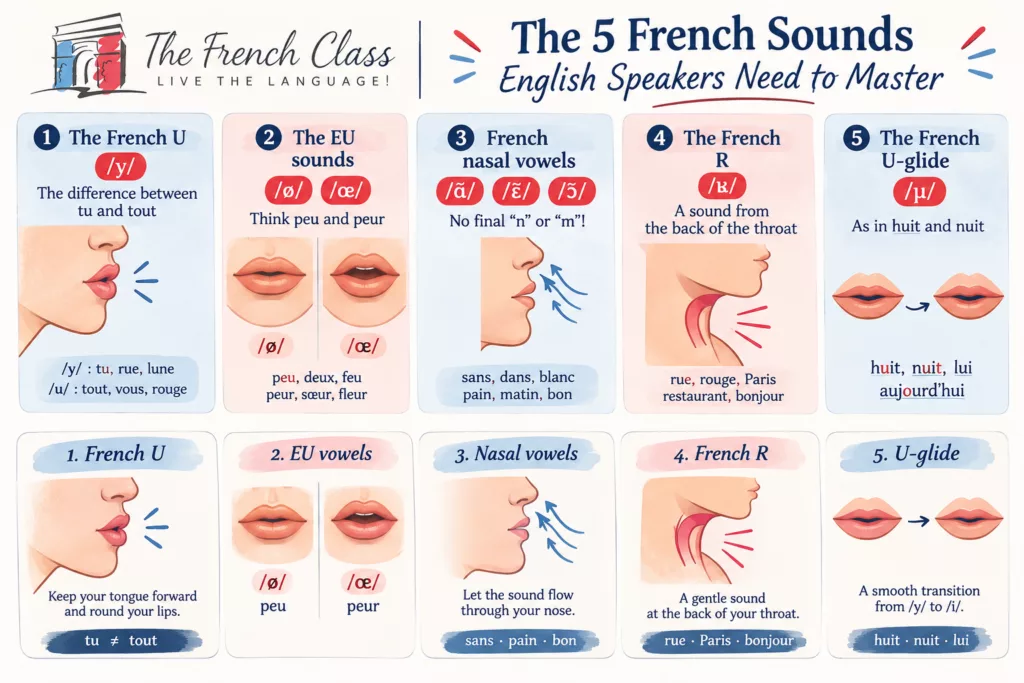
1. The French U /y/: Understanding the Difference Between Tu and Tout
In this guide, we explore five French sounds that English speakers often find difficult, with practical examples, pronunciation tips and exercises to help you speak French more naturally.
One of the most recognisable difficulties for English speakers is the French vowel /y/, as in tu (you).
English does not have this vowel. English speakers often pronounce it like the « oo » sound in too. However, these are two distinct sounds in French:
- /y/: tu (you), rue (street), lune (moon).
- /u/: tout (everything), vous (you), rouge (red).
This distinction matters because changing the vowel can completely change the meaning of a word.
How to pronounce the French U /y/
Try this simple exercise:
- Start by saying the English word « ee », as in see.
- Keep your tongue in exactly the same position.
- Round your lips as if you were going to say « oo ».
- Maintain the tongue position while rounding your lips.
You should now be producing the French /y/ sound!
Practise with these minimal pairs
- tu /ty/ – tout /tu/
- rue /ʁy/ – roue /ʁu/
- sur /syʁ/ – sous /su/
Remember: The secret is to keep your tongue forward while rounding your lips.
2. The French EU Vowels /ø/ and /œ/: Think Peu and Peur
French has two vowel sounds that can be particularly difficult for English speakers: /ø/ and /œ/.
Neither has a direct equivalent in standard English. Both are produced with rounded lips, but the main difference is how open your mouth is.
Examples of the French /ø/ sound
- peu (little) /pø/
- deux (two) /dø/
- feu (fire) /fø/
Examples of the French /œ/ sound
- peur (fear) /pœʁ/
- sœur (sister) /sœʁ/
- fleur (flower) /flœʁ/
How to pronounce /ø/ and /œ/
- For /ø/: Start with a relatively closed vowel position, similar to the tongue position for « ay » in English, then round your lips. Keep your mouth relatively closed.
- For /œ/: Open your mouth slightly more while keeping your lips rounded.
Practise these word combinations
- peu – peur
- deux – sœur
- feu – fleur
Try not to replace these sounds with English « er » or « uh ». The rounded lip position is essential!
3. French Nasal Vowels /ɑ̃/, /ɛ̃/ and /ɔ̃/
French nasal vowels are another major challenge for English-speaking learners.
Unlike English, French uses nasal vowels as an essential part of its sound system. A nasal vowel is produced when air passes through both the mouth and the nose. Importantly, you do not pronounce a separate « n » or « m » at the end of the word.
French has four main nasal vowel phonemes in traditional descriptions, although their realisation can vary. Here are three particularly common ones.
The /ɑ̃/ sound – as in Sans
Examples:
- sans (without)
- enfant (child)
- dans (in)
- chambre (room)
The /ɛ̃/ sound – as in Pain
Examples:
- pain (bread)
- matin (morning)
- vin (wine)
- important (important)
The /ɔ̃/ sound – as in Bon
Examples:
- bon (good)
- nom (name)
- maison (house)
- bonjour (hello)
How to practise French nasal vowels
Start by pronouncing the vowel without adding a final consonant. Then allow air to pass through your nose while keeping the sound continuous.
Try repeating these combinations:
- sans – sain – son
- dans – daim – don
- blanc – brun – bon
Pay attention to the differences between the three sounds rather than simply memorising their spelling.
Remember: French spelling does not always correspond directly to pronunciation. The same nasal vowel can be represented by different letter combinations.
4. The French R /ʁ/: A Sound Produced at the Back of the Throat
The French R is perhaps one of the most famous features of French pronunciation.
Unlike the English R, which is generally produced with the tongue raised or curled towards the front of the mouth, the standard French R is produced towards the back of the mouth, near the uvula.
It is typically a voiced uvular fricative or approximant.
Examples of the French R
- rue (street)
- rouge (red)
- restaurant (restaurant)
- bonjour (hello)
- Paris (Paris)
How to pronounce the French R
- Relax your tongue.
- Keep the tip of your tongue away from the roof of your mouth.
- Produce a gentle friction sound towards the back of your mouth.
- Avoid making the sound too harsh or exaggerated.
One useful exercise is to practise the sound in different positions:
- At the beginning: rue, rouge.
- In the middle: Paris, arriver.
- At the end: soir, bonjour.
Don’t worry if your French R is not perfect straight away. The goal is to develop a natural, relaxed pronunciation rather than an exaggerated throat sound.
5. The French U-Glide /ɥ/: As in Huit and Nuit
This is a less familiar French sound, but it is an important one to recognise.
The French sound /ɥ/ is a semi-vowel, also called a glide. It combines a rounded front-vowel position with a smooth transition into another vowel.
English speakers may replace it with a simple /w/ sound, but the French /ɥ/ is produced with the tongue further forward and the lips rounded.
Examples of the French /ɥ/ sound
- huit (eight) /ɥit/
- nuit (night) /nɥi/
- lui (him) /lɥi/
- huitième (eighth) /ɥitjɛm/
How to pronounce the French U-glide
- Start by saying the French /y/ sound, as in tu.
- Move smoothly into the /i/ sound, as in si.
- Avoid inserting an additional consonant between the two sounds.
Try repeating: huit, nuit, lui, aujourd’hui.
The key is to make the transition smooth and natural rather than pronouncing two separate vowels.
How to Improve Your French Pronunciation
Learning individual French sounds is an excellent starting point, but good pronunciation also involves rhythm, intonation, connected speech and listening skills.
Here are four practical ways to improve your French pronunciation.
1. Listen Actively
Pay attention to how native French speakers pronounce unfamiliar words. Podcasts, films, videos and everyday conversations are excellent sources of authentic pronunciation examples.
2. Practise Minimal Pairs
Rather than repeating isolated sounds indefinitely, practise words that differ by just one sound, such as tu/tout or peu/peur. This helps train your ear to recognise important differences.
3. Record Yourself
Record yourself saying individual words and complete sentences. Compare your pronunciation with a native speaker’s version. This can help you identify which sounds need more attention.
4. Practise in Context
Once you can produce an unfamiliar sound on its own, try using it in complete sentences. This will help you become more comfortable using it in everyday conversations.
Final Thoughts: Mastering French Pronunciation Takes Practice
French pronunciation is not simply about speaking more slowly or memorising spelling rules. It is about learning to recognise and produce sounds that may be unfamiliar to English-speaking learners.
Mastering the French U, the EU vowels, nasal vowels, the French R and the U-glide will give you a stronger foundation for speaking French with greater clarity and confidence.
Would you like to improve your French pronunciation with personalised guidance?
Caroline and her small team of French tutors offer individual private French lessons in Paris, adapted to your level, pronunciation goals and everyday communication needs.
Whether you are a complete beginner or an advanced learner, you can work on your pronunciation and develop greater confidence when speaking French.

