
If you’re learning French, there’s a good chance that depuis, pendant, and il y a have caused you a little confusion.
And honestly? You’re not alone.
These three little expressions all have something to do with time, but French uses them in very different ways. The good news is that once you understand the logic behind them, they become much easier to use.
So, let’s clear up the confusion — with a little help from your French tutor in Paris!
1. “Depuis” = Since / For
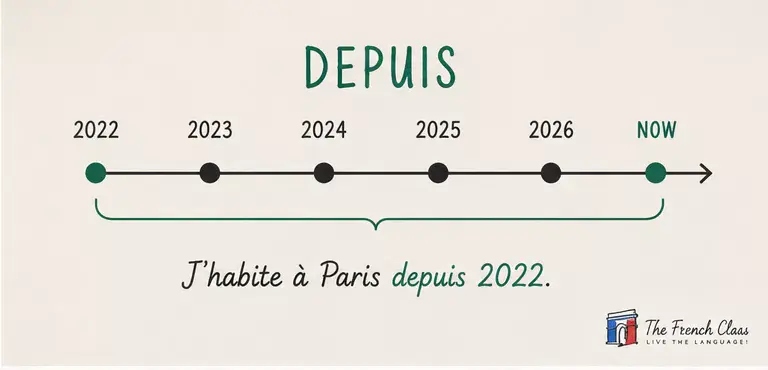
Let’s start with the one that causes the most trouble: depuis.
We use depuis when an action or situation started in the past and is still continuing now.
Think:
It started → it is still happening.
For example:
J’habite à Paris depuis 2020.
→ I have lived in Paris since 2020.
J’apprends le français depuis trois ans.
→ I have been learning French for three years.
Je travaille avec des étudiants depuis longtemps.
→ I have been working with students for a long time.
Notice something important: in French, we usually use the present tense after depuis when the action is still happening.
English vs. French
English:
I have lived in Paris for five years.
French:
J’habite à Paris depuis cinq ans.
Not:
❌ J’ai habité à Paris depuis cinq ans.
That would suggest something different — potentially that the situation is finished.
Caroline’s tip
When you see depuis, ask yourself:
“Is it still happening?”
If the answer is yes, depuis is probably your friend.
2. “Pendant” = For / During
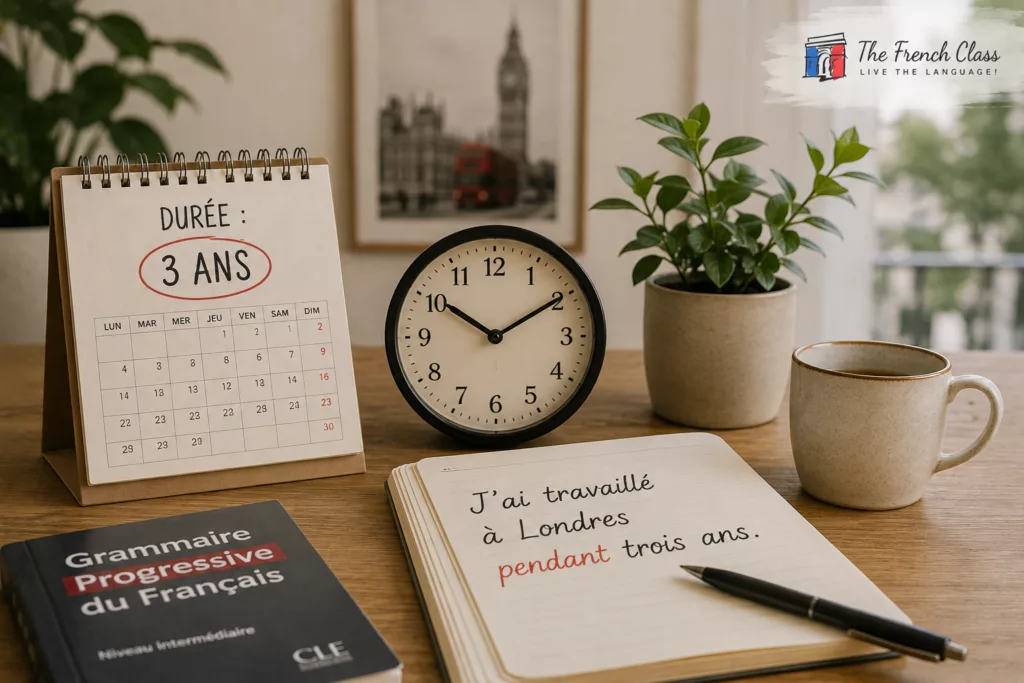
Now let’s meet pendant.
We use pendant to talk about a duration, usually when the action is considered as a completed or limited period.
Think:
It lasted X amount of time.
For example:
J’ai étudié le français pendant deux ans.
→ I studied French for two years.
Nous sommes restés à Paris pendant une semaine.
→ We stayed in Paris for a week.
J’ai travaillé dans une entreprise américaine pendant cinq ans.
→ I worked for an American company for five years.
In these examples, the period has an endpoint.
“Pendant” can also mean “during”
For example:
Je lis pendant le trajet.
→ I read during the journey.
Il a dormi pendant le film.
→ He slept during the movie.
Pendant les vacances, je déconnecte complètement.
→ During the holidays, I completely disconnect.
So remember:
pendant = a duration or a period of time
3. “Il y a” = Ago

And now for another very useful expression:
il y a
No, we’re not suddenly talking about the verb avoir. ?
When talking about time, il y a means “ago.”
For example:
Je suis arrivé à Paris il y a cinq ans.
→ I arrived in Paris five years ago.
J’ai commencé à apprendre le français il y a trois ans.
→ I started learning French three years ago.
Je l’ai rencontré il y a longtemps.
→ I met him a long time ago.
The structure is simple:
Il y a + period of time + past event
So:
il y a deux jours → two days ago
il y a trois semaines → three weeks ago
il y a six mois → six months ago
il y a dix ans → ten years ago
So… what’s the difference between Depuis, pendant and il y a?
Let’s compare the three expressions using the same idea.
Imagine you started learning French three years ago and you’re still learning it.
1. “Il y a” → tells us WHEN it started
J’ai commencé le français il y a trois ans.
→ I started French three years ago.
2. “Depuis” → tells us HOW LONG it has continued
J’apprends le français depuis trois ans.
→ I have been learning French for three years.
3. “Pendant” → describes a completed duration
J’ai appris le français pendant trois ans.
→ I studied French for three years.
The difference is subtle but important:
| French | Meaning | Idea |
|---|---|---|
| il y a trois ans | three years ago | When did it happen? |
| depuis trois ans | for three years / since three years ago | It started then and continues |
| pendant trois ans | for three years | Completed duration |
A Parisian example
Let’s imagine a student who has just moved to Paris.
She might say:
Je suis arrivée à Paris il y a six mois.
I arrived in Paris six months ago.
Then:
J’habite à Paris depuis six mois.
I have been living in Paris for six months.
And perhaps, after a few years:
J’ai habité à Londres pendant cinq ans avant de venir à Paris.
I lived in London for five years before coming to Paris.
See the pattern?
il y a → the starting point
depuis → something continuing until now
pendant → a completed period
Once you see it this way, it becomes much easier!
A common mistake for English speakers
One of the biggest traps is translating English word-for-word.
In English, you might say:
“I have lived in Paris for three years.”
It’s tempting to translate this as:
❌ J’ai vécu à Paris pour trois ans.
But French doesn’t work that way.
Instead:
✅ J’habite à Paris depuis trois ans.
And if the situation is finished:
✅ J’ai habité à Paris pendant trois ans.
The key question isn’t simply “How long?”
It’s:
“Is it still happening?”
If yes → depuis
If finished → pendant
Quick French challenge!
Ready to test yourself?
Choose depuis, pendant, or il y a.
1. J’habite à Paris ______ 2022.
2. Je suis arrivé en France ______ quatre ans.
3. J’ai travaillé à Londres ______ trois ans avant de déménager à Paris.
4. J’apprends le français ______ six mois.
Answers
- depuis → J’habite à Paris depuis 2022.
- il y a → Je suis arrivé en France il y a quatre ans.
- pendant → J’ai travaillé à Londres pendant trois ans.
- depuis → J’apprends le français depuis six mois.
How did you do?
One last tip from your French tutor
When you’re speaking French, don’t try to translate every word from English.
Instead, think about the relationship between the action and time:
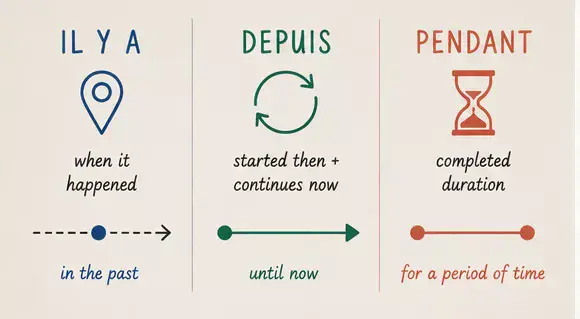
IL Y A
Something happened in the past.
DEPUIS
Something started in the past and continues now.
PENDANT
Something happened for a specific duration.
And if you’re learning French in Paris, you’ll hear these expressions constantly — at work, in cafés, on the Métro, in conversations with friends… everywhere!
So the next time someone asks:
“Depuis combien de temps tu habites à Paris ?”
you’ll know exactly what to say:
“J’habite à Paris depuis…”
Now you just need to decide how long you’ve been here! ?
Want to improve your French in Paris?
If you’d like to become more confident speaking French — not just memorising grammar rules — I offer private French lessons in Paris, adapted to your level, goals and interests.
We can work on grammar, conversation, pronunciation, vocabulary and, of course, all those little expressions that make your French sound much more natural.
À bientôt à Paris !
— Caroline
The French Class | Private French Lessons in Paris

